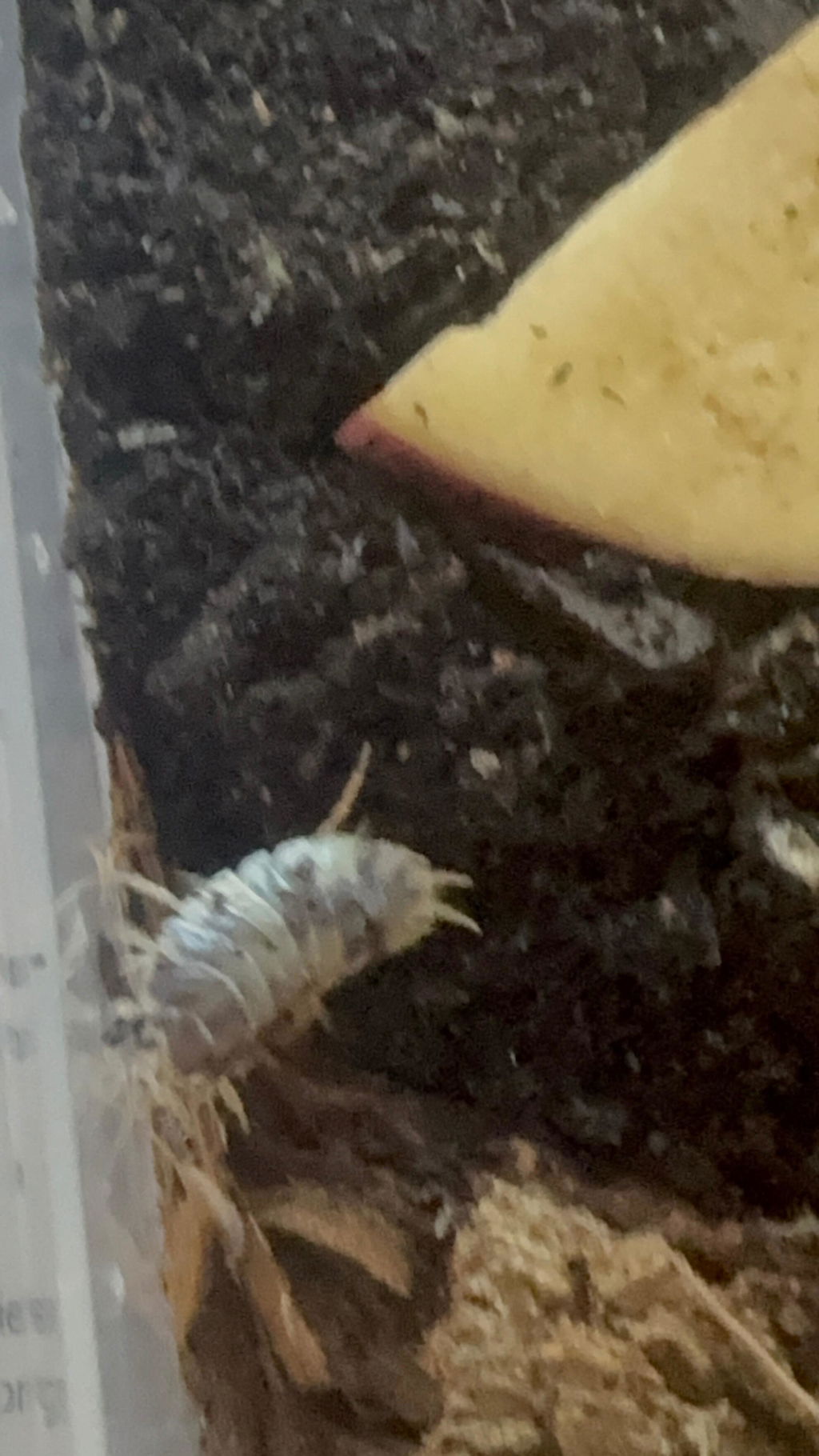
Dairy Cow Isopods — Porcellio laevis “Dairy Cow”
They’re hardy, highly prolific breeders and thrive in a semi-arid to moderately humid environment with good ventilation, plenty of leaf litter, decaying hardwood and access to moisture. Their bold black-and-white markings and large size make them a fantastic display isopod, clean-up crew and feeder. 🦎🐄
🌍 Origin: Porcellio laevis is native to Southern Europe, the Mediterranean region and North Africa and is now widely distributed around the world. The Dairy Cow is a captive-bred colour form rather than a separate species.
Excellent for semi-arid to moderately humid bioactive enclosures, provided they have access to a consistently moist refuge while the remainder of the enclosure is allowed to stay drier.
A good setup is:
- 💧 Moisture: Maintain a clear moisture gradient with one area kept damp and the remainder relatively dry. They should always have access to moisture but should not be kept in saturated substrate.
- 🏜️ Semi-arid enclosure: They are well suited to semi-arid setups when a damp retreat is provided. Good ventilation is important.
- 🍂 Food: Leaf litter and decaying hardwood should always be available. They also benefit from vegetables and supplemental protein, as Dairy Cows have a notably strong appetite for protein.
- 🪵 Hides: Cork bark, decaying wood and deep leaf litter provide excellent shelter and help create the moisture gradient.
- 🦴 Calcium: Keep a constant calcium source such as cuttlebone or calcium carbonate available for healthy growth and moulting.
- 🌡️ Temperature: Approximately 18–26°C (65–80°F) is a good general range. Avoid prolonged excessive heat.
- 📏 Adult Size: Approximately 1.5–2.3 cm (½–⅞ inch), with some individuals reaching around 2.5 cm.
Dairy Cows are one of the most popular beginner-friendly isopods because they are active, hardy and reproduce readily. Their larger size also makes them an especially substantial live feeder compared with smaller isopod species. Because they are fast, active and protein-hungry, they can sometimes outcompete smaller or more delicate isopods, so single-species cultures are often preferable when breeding them for sale.
Hardy • Fast breeding • Large & active • Great clean-up crew • Excellent nutritious feeder
*12–15 Isopods